 Square
Buying an NA Plot? Five Separate Questions to Resolve Before Planning a Building
“NA plot” is not a complete answer to “what can I build here?” Treat ownership, land-use position, planning context, building permission and access as questions to verify—even where the current procedure links more than one of them.
Have a plot, but an incomplete picture?
Tell Square Space where the land is, what you want to build and which records are available. We can discuss the architectural brief and identify information or specialist advice needed before design. This is not a title-certification service.
Calling? Mention the Square Space website. Share a description in the form, not private documents.
Replace the label with the supporting record.
An advertisement may say “NA”, “NA in process” or “ready to construct”. Ask which current document or authority position supports that claim, what property it identifies and what use it addresses. An application receipt and a completed permission record are not interchangeable.
Do not assume every site needs an identical separate NA-order process. Maharashtra’s land-revenue and planning frameworks contain connected provisions and have changed over time. The official Land Revenue Code reprint dated 2 April 2025 is a dated reference, not a complete statement of the law today. Ask the appropriate professional / authority to confirm current amendments, tenure and the route for the intended use.
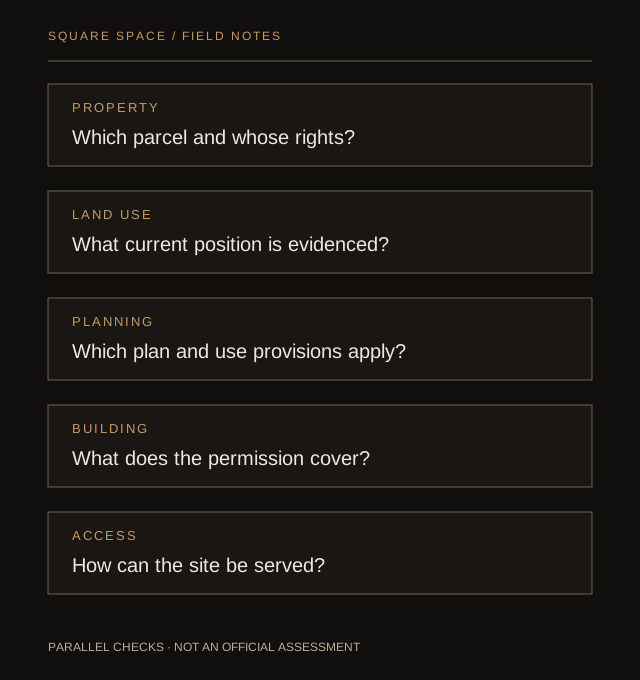
Keep these five questions separate in your file.
| Question | Evidence / professional input to discuss |
|---|---|
| Identity and rights | Plot identifiers and records, with independent legal advice for title, ownership or restrictions on transfer. |
| Land-use / conversion position | The applicable record, approval, conditions or current statutory treatment; do not rely solely on the seller’s terminology. |
| Planning context | Relevant zone, plan status, reservations and other site-specific provisions from the appropriate authority record. |
| Building / development proposal | What the actual sanctioned plan or permission covers, if one exists, and how it relates to what you now propose. |
| Boundary and access | Available measured information, road connection and any right-of-access issue; involve appropriate survey or legal specialists where needed. |
The DTP General FAQ describes a zone certificate as a planning document and identifies the planning-authority route for development proposals. That is a different purpose from reading a land-record entry or confirming title.
Use an evidence ledger instead of a yes/no checklist.
Write one row for each claim that affects your decision. Use four headings: claim; source / date; what it covers; what remains unverified. This makes it possible to discuss gaps without pretending an incomplete file has been cleared.
- “The plot is NA”: identify the actual record or applicable treatment and its stated use.
- “A house is sanctioned”: identify the plan, date, parcel and permitted scope.
- “The entire area is available”: check plan provisions, boundaries and access before relying on a layout.
- “Everything is approved”: list the individual records instead of treating that phrase as evidence.
These are representative statements an owner may encounter, not findings about a real Square Space client or project. A ledger does not verify the documents; it helps decide what must be verified and by whom.
A linked procedure does not make every question identical.
A current statutory route may connect land-use treatment with a planning approval. That does not mean a general “NA” description answers every detail about the building you want, its conditions or the land’s legal position. Equally, do not insist on an obsolete paperwork sequence simply because an older checklist lists it.
Ask: “Which current provision and authority record apply to this parcel and intended use, and what evidence should I retain?” Avoid a universal promise about conversion, a fixed turnaround time or a fee quoted without examining the site. The planning-map guide explains the distinct zone / reservation question.
For a farmhouse, describe the actual use.
A family retreat, a building connected with farming and a commercial hospitality proposal should not be silently described as the same project. State the intended occupation and activity before discussing the architectural scope. Do not infer building rights from agricultural ownership or from a Gram Panchayat reference alone.
Our farmhouse and rural-land planning page explains the preliminary discussion. It does not offer a universal farmhouse entitlement. Land-use, legal and specialist questions are confirmed for the particular property.
Prepare a conversation before commissioning a floor plan.
Bring the locality, available survey / Gat / CTS reference, intended use and a list of records—not confidential documents uploaded to the contact form. The official Maharashtra land-record gateway is a source for relevant record services; which record applies depends on the property.
For a plot in Bhiwandi, Kalyan or Thane, the site-feasibility conversation can identify the architectural questions. If the uncertainty concerns ownership or a dispute, use the professional-triage guide and appoint independent legal advice where appropriate.
Sources & scope.
- Official Land Revenue Code reprint — text as on 2 April 2025; subsequent provisions must be checked
- DTP — General FAQ on planning authorities, development permission and zone certificates
- Maharashtra land-record services gateway
General preparation guidance, not legal due diligence, a current-law eligibility determination, a title certificate or a guarantee of construction rights. No separate NA process is prescribed universally by this article. Sources reviewed 18 October 2026. Portal interfaces and applicable provisions can change.
Have a plot, but an incomplete picture?
Tell Square Space where the land is, what you want to build and which records are available. We can discuss the architectural brief and identify information or specialist advice needed before design. This is not a title-certification service.
Mention the Square Space website when calling. An appropriate paid scope, if needed, is agreed after discussing your requirements.